Best High RTP Slots UK: How Returns Work
RTP describes a slot’s theoretical return across an extended run of play, not the outcome of an individual spin or session.
 Available in GB

Table of Contents
- How RTP Describes a Slot’s Long-Term Return
- Top online casinos in the UK
- Comparing Online Casino Slots Without a Ranking
- Slot Games, Reels and the Shape of a Bet
- Online Slots: The Limits Around a Spin
- Slot Machines and the Small-Win Rhythm
- Low Volatility, Long Sessions and the House Edge
- Pragmatic Play Slots: What the Facts Can Support
- Why One Slot Cannot Be Named the Highest-RTP Choice
- What a Slot’s Return Does—and Does Not—Say
- The Highest-RTP Slot: A Claim That Needs Evidence
How RTP Describes a Slot’s Long-Term Return
Return to player, usually shortened to RTP, is a theoretical measure of how much a slot is designed to return over a very large number of spins. It is expressed as a percentage of the total amount staked. If a game is described as having an RTP of 96%, that figure means the mathematical model is built to return 96 pence for every pound wagered when play is extended far beyond the scale of an ordinary visit.
That description is deliberately impersonal. It refers to the game’s design, not to the fortunes of one person at one machine. A player can experience a profitable session on a game with a lower theoretical return, just as a player can lose money during a short session on a game with a higher one. RTP does not predict the result of the next spin, the next hour or even a particular run of play.
The percentage is therefore not a promise. It is closer to a long-range property of the game than to a forecast. A weather average cannot say whether rain will fall on one particular afternoon; RTP cannot say whether a bonus round will arrive before a balance disappears. Casinos have always been fond of turning uncertainty into ceremony, but mathematics remains less theatrical.
What the percentage actually describes
A slot’s advertised RTP is calculated from its rules, symbol values, winning combinations, bonus features and random-number system. Those elements produce a theoretical return when the game is considered across an enormous volume of play. The figure is useful because it provides a common measure: all else being equal, a higher RTP represents a smaller built-in margin for the operator than a lower RTP.
Games: Casino Slots, Live Tables and More · Fast Payout Online Casinos in the UK: What to Check
That comparison has limits. RTP does not state how frequently winning combinations appear, how large those wins may be or how sharply results can move from one spin to the next. Two games could display the same theoretical return while producing very different experiences. One might deliver modest wins at comparatively regular intervals; another might produce long quiet stretches interrupted by a much larger feature or payout.
The advertised percentage must also be read as a game-level statistic rather than as a personal allowance. A player does not receive a fixed portion of the stake back after each spin. Nor does an unsuccessful run create a debt that the slot must repay. Random outcomes do not keep a visible account of who has lost, and a previous result does not make a particular symbol combination due.
RTP and the timing of wins
The timing of returns is a separate question from their theoretical size. A slot can have a high RTP while distributing that return through occasional substantial wins. Another game can show the same or a similar RTP through many smaller winning combinations. The first may feel severe during a quiet spell; the second may feel gentler without changing the underlying edge.
This is why RTP alone cannot describe the rhythm of a session. It says where the mathematical return is aimed over the long term, not how the route is travelled. Volatility is the term commonly used for the spread and frequency of results, but it should not be treated as an alternative form of RTP. The two measures answer different questions:
- RTP: what proportion of stakes the game is theoretically designed to return over extensive play;
- Volatility: how unevenly wins and losses tend to be distributed;
- Short-session result: what happened during the particular sequence of spins that took place.
A higher RTP does not guarantee more frequent wins. A lower-volatility design may produce a steadier-looking stream of smaller returns, while a higher-volatility design may produce fewer winning events with greater variation in their size. Neither pattern overrides the advertised long-run return.
Why long-run language matters
“Long run” is not a decorative qualification. It is the part of the definition that prevents RTP from being mistaken for a short-term promise. The larger the number of spins considered, the more meaningful the theoretical comparison becomes. Yet even extensive play does not turn the percentage into a guaranteed personal outcome. It remains an expectation calculated across the game’s overall mathematical model.
The operator’s advantage is expressed through the house edge, which is the portion not theoretically returned to players. Where that edge is positive, the corresponding mathematical expectation for the player is negative over enough sessions, however gradually the losses appear. A smooth sequence can make the disadvantage less conspicuous; it cannot remove it.
RTP and the House Edge
Return to player (RTP) is a theoretical measure of how much a slot is designed to return over a very large number of spins, expressed as a percentage of the total amount staked.
The operator’s advantage is expressed through the house edge, which is the portion not theoretically returned to players. Where that edge is positive, the corresponding mathematical expectation for the player is negative over enough sessions.
That distinction matters when games are described as the best or highest-RTP options. RTP can support a comparison only when the relevant game-specific figure is established and the rest of the design is considered alongside it. It cannot, by itself, identify the most enjoyable game, the most suitable session rhythm or the slot most likely to produce a win at a particular moment.
A percentage is information, not an omen.
Top online casinos in the UK
- BritsinoBonus: Welcome Package – Get your £2,200 + 2,000 FS · Payout speed: 1-3 business days
- Revery PlayBonus: 100% up to€1,000+ 100 FS · Payout speed: 1-3 business days
- AmunbetBonus: Join now and get 450% up to 2,700 GBP + 450 FS · Payout speed: 1-3 business days
- ZombillionBonus: Welcome Pack 250% up to £4000 + 200 FS · Payout speed: 1-3 business days
- x3betBonus: Welcome Pack 100% Up to £1.000 + 200 Free Spins · Payout speed: 1-3 business days
- NightLuckBonus: Welcome Pack + 805% Up To 6400€ + 280 FS · Payout speed: 1-3 business days
- BeOnBetBonus: 100% up to €500 + 100 FS · Payout speed: 1-3 business days
Comparing Online Casino Slots Without a Ranking
The phrase “best online casino slots with the highest RTP” sounds as though it should produce a neat table: game name, provider, return percentage, perhaps a badge beside the apparent winner. Slot comparison is less orderly. A game’s advertised return is a property attached to a particular title and configuration, while the setting in which that title appears is a separate matter. A casino may offer many games, but its catalogue alone does not establish which one has the highest RTP or the gentlest volatility.
A useful comparison therefore begins by separating three questions:
- What game is being discussed?
- What return figure belongs to that game and version?
- Under what conditions is the game offered?
Without those distinctions, “highest RTP” becomes a loose compliment rather than a measurable description.
Game information comes first
A credible slot comparison needs a specific, identifiable game. The title should be clear, and the listed RTP should relate to that title rather than to a provider’s wider portfolio or to slots in general. Different versions, settings or distributions can matter, so a percentage detached from the game’s information is not a sound basis for a league table.
The same applies to volatility. “Low volatility” describes the pattern of returns, not a superior RTP by itself. A slot may be designed around more frequent, smaller wins, while another may produce winning combinations less often and make larger awards possible. These are different characteristics. Treating volatility as a substitute for RTP turns two separate measurements into one rather fashionable blur.
The language of “top ten” is especially tempting because it suggests certainty. Yet a list can only rank items that have been identified and measured on comparable terms. A catalogue of unnamed “high-RTP slots” is not a list of games; it is a description without objects.
The casino and the game are not the same thing
Online casino comparison adds another layer. The Gambling Commission regulates commercial gambling in Great Britain and is the sole regulator for commercial gambling there. Its remit covers remote gambling offered to consumers in Great Britain, wherever the key equipment is located. That is a statement about regulatory oversight, not a ranking of the games available through an operator.
The Commission issues operating licences to businesses and personal licences to individuals working in the industry. An operating licence can establish that a business is authorised within the relevant regulatory framework; it does not turn every title in a catalogue into the highest-return choice. The operator, the game provider and the individual game each occupy a different place in the chain.
Regulatory Oversight
The Gambling Commission regulates commercial gambling in Great Britain and is the sole regulator for commercial gambling there, covering remote gambling offered to consumers in Great Britain.
That distinction prevents a common shortcut: assuming that a casino advertising a broad slot selection must also contain the best RTP slot. Availability is not performance. A large shelf is still only a shelf.
What can sensibly be compared
Online slots can be assessed across a small set of clearly defined features:
- Identifiable title — the game must have a name that distinguishes it from other releases.
- Game-specific RTP — the return figure must belong to that title and its relevant version.
- Volatility — the expected rhythm of wins should be described separately from the long-run return.
- Rules and pay structure — the way combinations, features and prizes operate affects the character of play.
- Availability — a game must actually be offered by the casino being considered.
- Regulatory setting — the operator’s status concerns the legal framework, not the mathematical ranking of its games.
This framework also explains why “highest RTP, lowest volatility” is not automatically a single category. One attribute concerns long-run theoretical return; the other concerns how unevenly that return may arrive. Combining them can be useful for filtering, but it does not create a universal winner.
Why a universal list misleads
A ranking implies that every candidate has been examined using the same information. If one title has a confirmed RTP, another has only a promotional description, and a third is classified by volatility alone, placing them in one ordered table gives unequal evidence the appearance of equality.
There is also a difference between a game being available at an online casino and a casino making a claim about its games. The operator’s catalogue may change, and the relevant details belong to individual titles. A broad statement about “the best slots” cannot carry the precision of a game-specific description.
For the same reason, a casino’s licence should not be treated as a quality score for its slot mathematics. Regulation defines who may offer commercial gambling and under what oversight. It does not award medals for RTP.
Best Bonus Buy Slots UK: How the Feature Works
The sensible comparison is consequently a labelled one: title against title, RTP against RTP, volatility against volatility, and availability against availability. Once those categories are kept apart, the language becomes less dazzling but more useful. No imaginary champion required.
Slot Games, Reels and the Shape of a Bet
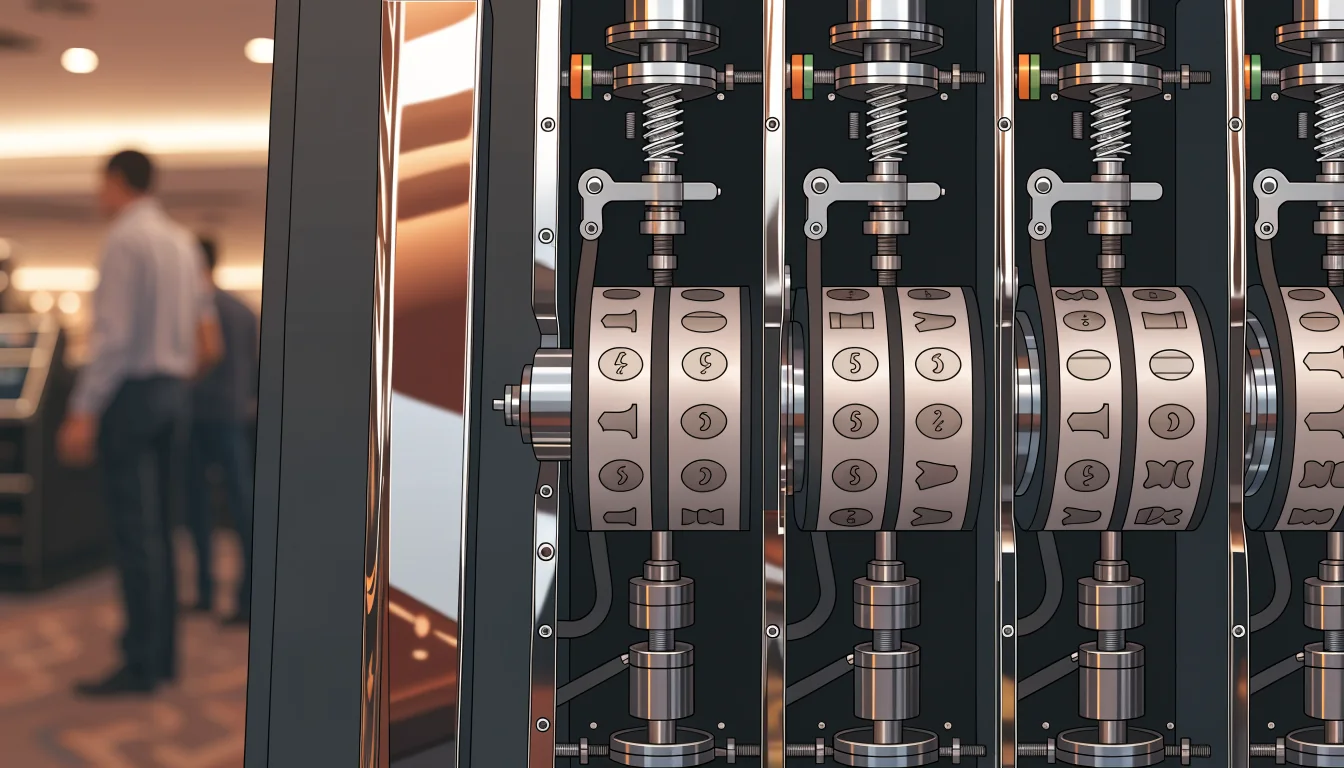
A slot game begins with a visual arrangement that is easy to recognise: reels, symbols and a result produced after the reels stop. The apparent simplicity is deceptive. The reels are not merely decoration, and the bet is not necessarily attached to one symbol or one visible line. It is a small system of routes through which a stake can be measured and a combination can be assessed.
The familiar format is a row of vertical reels. A five-reel game has five such columns, each carrying symbols that appear as the reels turn. Once the movement ends, the symbols occupy positions beside one another. The resulting pattern is then examined according to the game’s winning rules. That is the mechanical meaning behind the phrase “5 reel slot games”: it describes the number of reels, not the quality of the returns, the size of the prizes or the reputation of the provider.
5 reel slot games
A format where the reels consist of five vertical columns, each carrying symbols that appear as the reels turn to produce a resulting pattern.
The distinction matters because a game’s appearance can suggest more than it actually tells. Five reels may look like five separate objects, yet the bet can be arranged across the complete set. A five-reel slot can have one bet applied across all five reels. In that structure, the stake is not simply divided into five independent little wagers. It is attached to the game’s defined play, with the full reel arrangement contributing to the possible result.
Reels are not five separate games
The reels work together. A symbol on the first reel can matter because of what appears on the second, third, fourth or fifth. The game’s rules determine which connected arrangements count, and whether the connection must follow a marked line, a cluster, or another pattern. The visible columns therefore form one playing field, even when the eye initially reads them from left to right as separate strips.
This is why the word “slot” can be misleadingly modest. It recalls the old machine with a single opening for a coin, but the modern game is closer to a compact diagram of possible relationships. The reels supply the moving parts; the symbols provide the vocabulary; the pay structure decides which sentences are considered meaningful. A winning combination is not just a pleasing picture. It is an arrangement recognised by the rules attached to that particular game.
The bet sits underneath this arrangement. It may be described through paylines or other game-specific mechanisms, but the central idea remains that a spin activates the game’s structure rather than one isolated reel. Where a bet covers all five reels, the outcome is judged across the five-reel layout. The stake and the visible result belong to the same cycle of play.
Best Keno Online Casinos in the UK: How to Choose
Why the reel count does not settle the question of value
A five-reel design says something about construction, but it does not by itself identify the game with the most favourable return. Reel count cannot establish a ranking of games, and it cannot turn a familiar layout into evidence of a particular RTP. Two games may use five reels while differing in symbols, winning routes, bonus arrangements and mathematical settings.
That is also why labels such as “best” or “highest return” need more than a picture of the cabinet or screen. The architecture of a slot explains how its result is assembled. It does not, on its own, explain how frequently particular outcomes occur or how the long-run return is calculated. Those are separate properties, even when promotional language places them side by side.
The same restraint applies to online slot games. A digital interface can reproduce the look of reels without changing the basic question: what does the bet activate, and which arrangements does the game recognise? The screen may animate the answer with lights, sounds and expanding symbols, but the underlying shape is still a wager connected to a defined reel layout.
The bet gives the picture its boundaries
Without the bet, the reels are only movement. Without the reels and their rules, the bet has no game to enter. Their relationship gives a slot game its particular form: a stake is applied, the reels produce an arrangement, and the rules interpret that arrangement.
This does not make every five-reel game equivalent. It simply gives the term a precise mechanical centre. Five reels indicate the field across which the symbols appear; a bet applied across all five reels indicates how that field can be activated. The rest belongs to the individual game’s documented rules, not to the number five.
- Verify the specific game title and its version
- Check the advertised RTP for that specific configuration
- Understand the volatility and rhythm of the game
- Assume a large casino catalogue implies the best RTP
- Treat volatility as a substitute for RTP
- Confuse a regulated operator with a high-return guarantee
A modest diagram, then. Five columns, one wager, many possible arrangements.
Online Slots: The Limits Around a Spin
An online slot in Britain does not run as quickly as a restless finger might suggest. At least 2.5 seconds must pass from the beginning of one game cycle before another can start. The interval belongs to the structure of the game, not to the mood of the person playing it. A sequence of rapid decisions is therefore interrupted by a fixed piece of time: the machine may be digital, but it is not allowed to behave like a slot-shaped metronome.
That rule also explains why autoplay is not part of the British online-slot framework. Spins cannot be set running automatically while the account holder watches the result arrive. Each game cycle has to be initiated separately. The arrangement removes one familiar shortcut from casino interfaces: the player cannot turn a chosen number of spins into a mechanical procession and leave the system to continue by itself.
The practical effect is modest but important. A spin has a beginning, a result and a pause before the next cycle can commence. The pause does not change the underlying design of a game, but it changes how quickly decisions can accumulate. Time becomes a boundary around expenditure, which is rather less glamorous than the language of entertainment and rather more useful.
Stake limits depend on age
The maximum stake for an online slot game cycle depends on the customer’s age:
- customers aged 25 and over may stake no more than £5 per game cycle;
- customers aged 18 to 24 may stake no more than £2 per game cycle.
These limits concern online slots rather than every activity found in an online casino. They apply to the amount staked in an individual game cycle, so the relevant unit is the spin itself, not an abstract daily allowance or a general account balance. A casino account may contain several kinds of games, but the rule follows the game category.
A specialist review is the kind of source that reports these age-related limits, and the subject is one that can change as regulation develops. The figures should therefore be read as a description of the stated framework rather than as a timeless feature of casino culture. Gambling regulation has never been famous for standing still.
Age verification sits before the financial part of the arrangement. Operators must establish that a customer is aged 18 or over before allowing funds to be deposited into a gambling account. The age bands for slot stakes do not create a lower legal gambling age; they describe different limits within the adult market. For younger adults, the permitted slot stake is narrower.
Slots are not roulette or blackjack
An online casino is an umbrella, not a single machine. Slots, roulette and blackjack may appear beside one another on the same platform, yet they are different forms of gambling with different mechanics and different regulatory treatment.
A slot game produces its result through a programmed sequence associated with the game’s reels, symbols and pay structure. Roulette is organised around a wheel and a ball. European and French roulette use a wheel with 37 pockets, including a green zero and numbers 1 to 36; American roulette has an additional double zero, making 38 pockets. Blackjack is built around cards, with the outcome shaped by the relationship between the player’s hand and the dealer’s hand.
Stake Limits
Maximum stakes are restricted by age: customers aged 25 and over may stake no more than £5 per game cycle, while those aged 18 to 24 are limited to £2 per cycle.
The British online-slot stake limits do not apply to roulette or blackjack, according to a specialist review. That distinction matters when a casino menu makes all three activities look like variations on the same product. They share a payment account and a digital setting, but not the same game-cycle rules. A roulette wager is placed before the ball is released; a slot spin is a separate cycle governed by its own timing and stake conditions; blackjack proceeds through card decisions and dealer play.
The label “online casino” is therefore too broad to settle a question about limits. The category contains several games, and the boundaries around a spin belong specifically to slots. The wheel has its own history. The cards have theirs. The reels are subject to a rather stricter clock.
Slot Machines and the Small-Win Rhythm
A low-volatility slot is built around regular, modest results rather than rare dramatic payouts. Its design tends to spread the action across the visible window: several reels turn, multiple paylines run through the symbols, and a winning combination may return a small amount without producing the theatrical pause associated with a large prize. The machine’s rhythm is therefore less like a succession of jackpots than a steady sequence of minor interruptions.
A typical construction uses five reels and at least twenty-five paylines. The reels provide the familiar vertical columns, while the paylines define the routes along which matching symbols can form a win. A bet can cover those lines together, making the arrangement feel busy even when the individual prizes remain restrained. More lines mean more possible winning paths, but not a promise of a larger overall return. The architecture describes how a result is assembled, not whether a session will be favourable.
Best Video Slots UK: How the Games Work
That distinction matters because the phrase “highest RTP slot machines” often encourages attention to a single percentage while overlooking the shape of the play. A low-volatility machine may produce wins more often than a high-volatility one, yet those wins are generally smaller. The result is a gentler-looking sequence: a symbol lands, a line pays, the reels continue. Nothing in that sequence turns a loss-making mathematical proposition into a profitable one.
Fixed prizes and controlled drama
Low-volatility machines also tend to use fixed jackpot amounts rather than progressive pools. A fixed jackpot remains attached to the game’s stated structure, rather than growing through contributions from play across a network. It gives the machine a defined upper feature without making the prize itself a moving public spectacle. Progressive jackpots belong to a different emotional economy: they advertise accumulation. Fixed jackpots keep the emphasis on the machine’s own arrangement.
Bonus rounds commonly build on accumulated wins through multipliers. Instead of introducing a separate prize pool, the feature may take the value already gathered during the sequence and alter it with a multiplier. This gives the bonus round a sense of escalation while preserving the same basic grammar: symbols, combinations and calculated additions. The machine briefly raises its voice, but it does not necessarily change its character.
Mathematical Reality
A winning animation and a favourable balance are not the same event; the latter depends on the wider mathematics of the game.
Such features help explain why searches for the best slot machine with the highest return can blur unlike qualities. Return, volatility, reel layout, payline structure and bonus design answer different questions. A machine may be attractive because its wins arrive in a frequent, measured pattern; another may appeal through less common but more substantial payouts. Neither description, by itself, establishes which one has the highest long-run return.
The small-win rhythm can feel reassuring because it interrupts losing runs with visible successes. That feeling is part of the design’s social history: gambling machines have long learned that occasional acknowledgement keeps attention better than silence. Yet a winning animation and a favourable balance are not the same event. The former is immediate; the latter depends on the wider mathematics of the game.
Low volatility, then, is principally a description of distribution. It says that returns are spread across more frequent, smaller wins, while higher volatility concentrates returns into less frequent, larger ones. The reels, paylines, fixed jackpots and multiplier-led bonuses give that distribution its mechanical costume. The costume is persuasive. The mathematics remains underneath.
Low Volatility, Long Sessions and the House Edge
Low volatility changes the texture of a slot session more than its destination. Winning combinations tend to arrive more often, but their individual value is generally smaller than in a high-volatility game. Across most low-volatility titles, a winning combination appears every three to six spins on average. That rhythm can make a balance move less dramatically from one spin to the next, with frequent modest returns interrupting longer stretches of nothing.
Best 3-Reel Slots UK: Classic Reels Explained
It is easy to mistake that interruption for an advantage. A slot that returns something regularly feels less severe than one that remains silent and then produces an occasional larger result. Yet frequency and profitability are separate ideas. One describes how often winning combinations appear; the other concerns the value of all returns compared with the amount staked over time.
For that reason, a low-volatility slot may suit a longer, steadier style of play without becoming a favourable mathematical proposition. The session can feel more generous because losses are distributed in smaller steps. A high-volatility game makes the opposite bargain: fewer winning combinations, greater swings and a larger role for isolated results. Neither pattern changes the underlying expectation attached to the game.
The house edge is the part that remains indifferent to the mood of the reels. Where a game has a positive house edge, its mathematical expectation is negative for the player over enough sessions. That remains true whether losses arrive in abrupt drops or are softened by a succession of small wins. The gentler route is still a route in the same direction.
This distinction matters when low volatility is paired with claims about high return. A return figure and a volatility label describe different properties. The first concerns the theoretical share of stakes returned across a very long run; the second describes how unevenly that return tends to be distributed. A title may therefore appear attractive on both measures, but the labels do not turn a short session into a predictable outcome.
Longer play can make the contrast more visible. Frequent small wins may extend the time before the balance changes substantially, while the accumulated house edge continues to operate in the background. A smoother sequence is not a reversal of the mathematics.
Smoother, not safer.
Does a high RTP guarantee frequent wins?
No. A higher RTP does not guarantee more frequent wins; volatility determines the frequency and distribution of those wins.
Is a low-volatility slot safer?
Not necessarily. Low volatility means returns are spread across more frequent, smaller wins, but the underlying house edge remains the same.
Can I use autoplay in the UK?
No. In the British online-slot framework, spins cannot be set running automatically; each game cycle must be initiated separately.
Pragmatic Play Slots: What the Facts Can Support
Pragmatic Play is a game provider, not a single slot and not a single return rate. Its catalogue may contain games with different mathematical settings, volatility profiles and bonus structures. Treating the provider’s name as though it identified one common RTP would flatten several separate products into one convenient, but unreliable, label.
The same care applies to descriptions such as “highest RTP”. That phrase belongs to a comparison between named games and their applicable settings. A provider-wide reputation cannot establish which title leads, while a title name without its published game information says little about the return figure attached to a particular version.
Volatility is a separate question. A lower-volatility slot is associated with more frequent, smaller returns; a higher-volatility slot tends to produce winning combinations less often, with larger potential swings. Neither description identifies the RTP. A game can therefore be discussed in terms of its rhythm without being presented as a high-return Pragmatic Play title.
There is also a practical distinction between a provider search and a general search for real money slots. The first narrows attention to games supplied by Pragmatic Play. The second concerns the wider market and may include products from NetEnt, Betsoft, Elk Studios, Evolution, Microgaming, Play’n GO, Playtech or Red Tiger. Provider identity helps describe who made a game; it does not, by itself, rank the mathematics of the finished product.
A serious comparison keeps several labels apart:
- Provider: the company that supplied the game.
- RTP: the stated long-run return for the relevant game configuration.
- Volatility: the usual distribution and size of winning combinations.
- Game version: the settings and presentation offered by a particular operator or market.
That last distinction is easily overlooked. A slot title may appear familiar while its displayed information, available settings or presentation deserves separate checking. A polished theme is not a mathematical certificate. Nor is a famous studio’s name.
Pragmatic Play slots can be assessed when a specific title is accompanied by clear, applicable game information. Until then, “highest RTP Pragmatic Play slot” is a description of a comparison to be demonstrated, not a prize that belongs automatically to the provider’s catalogue. No shortcut there.
Why One Slot Cannot Be Named the Highest-RTP Choice
The phrase “highest-RTP slot” sounds as though it should produce a single, permanent answer. In practice, RTP belongs to a particular game configuration, not to the word slot in the abstract. A title may exist in more than one version, and the published return can depend on the configuration made available by a particular operator. Treating the label as a universal crown makes the comparison appear more exact than it is.
There is also a difference between a high theoretical return and a superior choice in every other respect. RTP does not identify volatility, the frequency of winning combinations, the size of individual prizes or the structure of bonus features. Two games can therefore present different experiences while appearing close in return terms. One may distribute results more evenly; another may place greater weight on less frequent outcomes. The arithmetic is only one part of the machine’s character.
The same caution applies to casino comparisons. A casino does not have one RTP covering every game it offers. RTP is attached to individual titles and, where relevant, their available settings. A business may host games from several providers, with different rules and mathematical profiles across the catalogue. Calling one casino the highest-RTP casino confuses the venue with the games supplied there.
Understanding RTP
- RTP is a long-term theoretical measure, not a short-term promise.
- Volatility describes the rhythm and distribution of wins, which is distinct from RTP.
- No single game can be universally declared the highest-RTP choice without specific, current configuration data.
- Regulation ensures legal oversight but does not award high-return status to games.
The British setting adds a further practical boundary. Remote gambling operators serving Great Britain must hold a Gambling Commission licence, and online slots operate within rules that include stake limits and a ban on autoplay. Those conditions describe how gambling is offered; they do not turn one title into the definitive highest-return slot.
So the careful answer to the singular question is narrower than a league table: no specific game can be declared the highest-RTP choice as a general fact. A meaningful comparison requires a named title, its applicable configuration and a reliable game-specific RTP statement. Without those particulars, the superlative is decoration rather than evidence. An impressive label, nothing more.
What a Slot’s Return Does—and Does Not—Say
A slot’s return figure describes a theoretical relationship between the money staked and the money paid back over a very large number of game cycles. It is a property of the game’s mathematical design, not a forecast printed for one evening’s entertainment. The figure may help describe how a slot behaves in the long run, but it cannot tell the story of the next few spins.
That distinction matters when asking which slot has the highest RTP in the UK. A game associated with a stronger long-term return does not owe a particular session a profit, a win, or even a reassuring sequence of small prizes. Random outcomes do not arrive as instalments from a personal account. A run can contain wins, losses, or an abrupt change of fortune while the underlying return calculation remains exactly what it was.
Nor does RTP reveal the rhythm of those outcomes by itself. Two casino games may be discussed in return terms while producing quite different experiences: one may distribute results more evenly, while another may leave longer gaps between wins and make larger individual payments when they occur. Return and volatility describe different aspects of a game. Confusing them turns a statistical description into a promise.
Best High-Volatility Slots in the UK: How They Play
The same caution applies when casino games are compared as a group. Roulette, blackjack and slots do not become interchangeable merely because each can be discussed through mathematical expectation. Their rules, outcomes and betting structures differ, so a return figure cannot serve as a universal quality label across every casino game.
There is also a less glamorous piece of arithmetic. Any game carrying a positive house edge has a negative mathematical expectation for the player over enough sessions, whether losses arrive in a jagged rush or are softened by frequent modest wins. A gentle-looking sequence is still not a change in ownership of the mathematics.
RTP describes a horizon. It does not describe tonight.
The Highest-RTP Slot: A Claim That Needs Evidence
Calling one game the highest-RTP slot is not a matter of taste. It is a factual claim about a particular title, its stated return figure and the version available in the relevant market. Without those details, the phrase sounds precise while remaining untested.
First Deposit Bonus Casinos UK: Terms and Rules
That distinction matters because a slot’s advertised return belongs to the game configuration, not to its name alone. Different versions, operators or settings can make a title unsuitable for a universal label. A figure copied from an old listing, attached to another configuration or separated from its source may create confidence without creating accuracy.
The same caution applies to the United Kingdom. A game may be described as high return in general terms, yet that does not establish that it is the highest available choice for British players. Nor does a familiar provider name settle the question. Reputation is not a percentage.
A defensible answer therefore needs a current, game-specific figure and enough context to show what that figure describes. Where that evidence is not established, no single slot can honestly be crowned the winner. The useful distinction is simple: an attractive claim is not the same thing as a demonstrated result.
Accuracy is less theatrical. It is also more valuable.
Created by the "Casino not on Gamstop" editorial team.