Online Casino American Roulette UK: Wheel and Play
See how American roulette’s wheel layout shapes the table, each round and the online versions available for real-money play.
 Available in GB
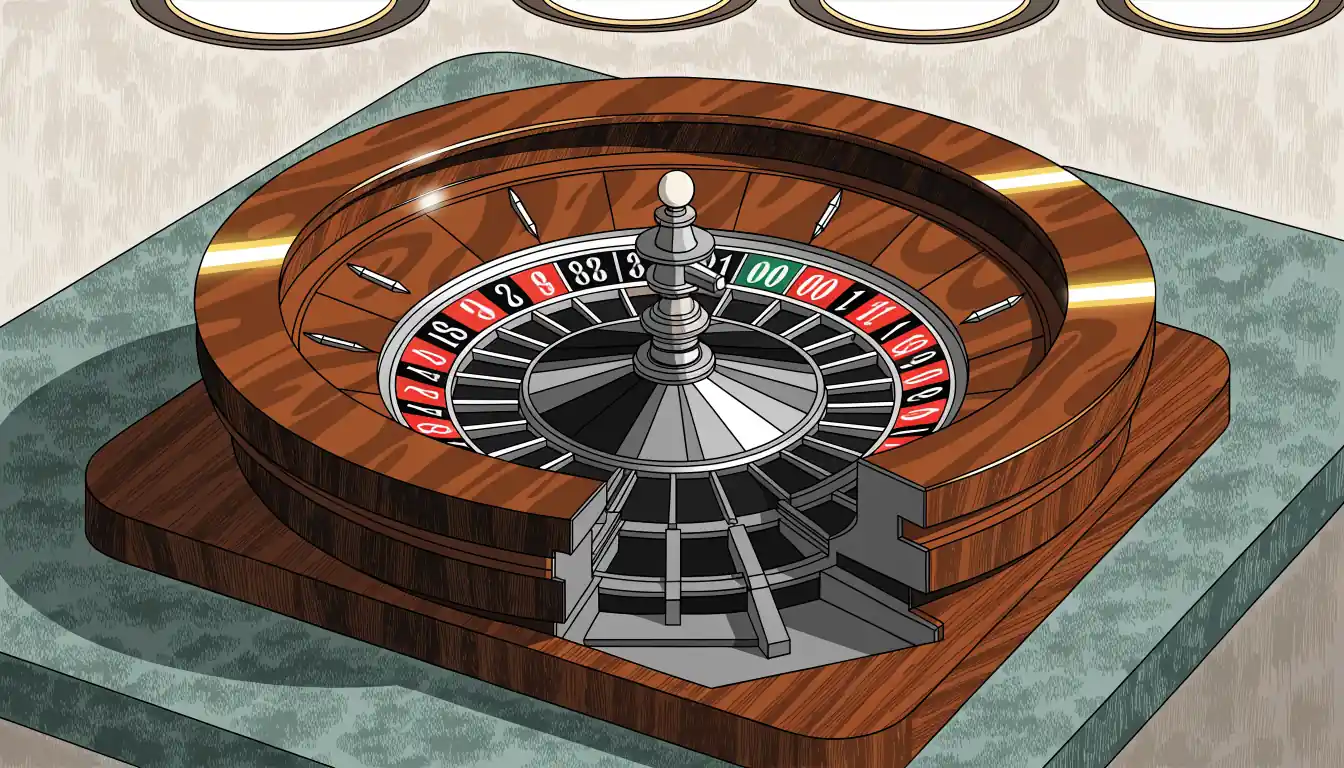
Table of Contents
- What the American Roulette Wheel Puts in Play
- Top online casinos in the UK
- Reading the American Roulette Table
- How an American Roulette Round Works
- American Roulette as an Online Casino Game
- Playing American Roulette for Real Money
- Live American Roulette: Dealers, Studios and Familiar Tables
- Finding an American Roulette Casino Without a False Promise
What the American Roulette Wheel Puts in Play
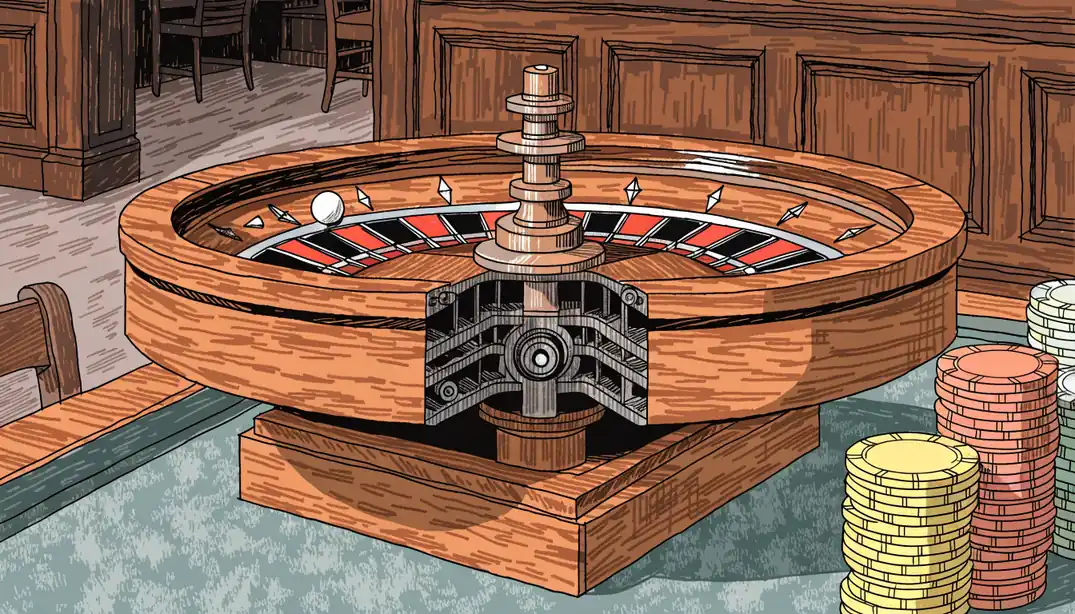
An American roulette wheel is a circle divided into numbered pockets. A small ball travels around the rim before dropping into one of them, turning a smooth piece of equipment into a machine for assigning chance. Its appearance is familiar: alternating red and black numbers, green pockets, and a ring of figures arranged around the bowl. Yet one feature separates it sharply from the European wheel. It has both 0 and 00.
That second zero is not a decorative flourish. It is the defining mark of the American wheel, sometimes called the double-zero wheel. Counting every numbered compartment, it has 38 pockets: the numbers 1 through 36, plus 0 and 00. The question “how many pockets are on an American roulette wheel?” therefore has a precise answer. Thirty-eight.
The numbered ring
The pockets numbered 1 to 36 are divided between red and black. The numbers do not run around the wheel in simple numerical order. Their sequence is arranged according to the traditional wheel layout, with high and low figures, odd and even figures, and red and black pockets distributed around the circumference. This arrangement gives the wheel its recognisable visual rhythm without changing the basic character of any individual number.
Each pocket is narrow and slightly sloped, designed to receive the ball after it loses momentum. The ball may touch the separators between pockets before settling, which is part of the theatre of the object: the result appears to hesitate even though the wheel and ball are following ordinary physical motion.
The green pockets are different from the coloured numbered pockets. Zero is marked 0, while the extra pocket is marked 00. They sit as separate destinations, not as a combined “zero” space. The distinction matters because a ball landing in either one produces a result unlike a landing on a red or black number.
A double-zero wheel, then, is not simply a European wheel with a larger label. The additional pocket changes the mathematical shape of the game. There are more possible landing places, while the familiar red, black, odd, even, high and low groupings still concern only the numbered pockets. The green spaces stand outside those ordinary colour and number families.
Online Casino Tournaments UK: Rules, Prizes and Entry
Why 0 and 00 matter
The extra zero gives the American wheel its particular house advantage. On a wheel with only 0, the numbered pockets account for a larger share of all possible destinations. Add 00, and the same broad outside categories—such as red or black—cover fewer of the wheel’s total pockets.
This is why the two green spaces deserve attention before any discussion of casino software, table design or the movement of a round. They alter the relationship between a chosen category and the whole wheel. A wager on red is concerned with red pockets, not merely with whether the ball avoids one green mark. On the American wheel, it must avoid two.
The effect is easy to miss because 0 and 00 occupy little visual space compared with the wide ring of red and black. Roulette has always had a talent for making its mathematics look like decoration. The green pockets are small, conspicuous and quietly decisive.
The extra pocket also affects straight-number selections. A numbered choice from 1 to 36 remains a single destination, while 0 and 00 are each individual destinations of their own. They are not interchangeable, and neither belongs to the red or black sequence. The wheel therefore offers 38 distinct outcomes, even though much of the surrounding language of roulette is built around the 36 conventional numbers.
A wheel with a history in its design
The American arrangement belongs to the wider roulette tradition that developed from European gaming culture and was adapted for American casinos. The double zero became a visible sign of that adaptation. It made the wheel recognisably different while preserving the central spectacle: a ball circling a numbered track, the final pocket revealed only after motion has done its work.
There is an almost bureaucratic neatness to the object. Every compartment has a place; every colour follows a pattern; the two green spaces interrupt that pattern with official-looking exceptions. The wheel promises no mystery about its construction. Its drama comes from not knowing which of the clearly marked destinations will receive the ball.
For online casino American Roulette, the physical wheel may be represented by software rather than shown as a full-size object. Even then, the relevant identity remains the same when the game is based on the American layout: the virtual wheel contains the 1–36 sequence together with 0 and 00. A digital display can animate the rotation, but it cannot remove the defining second zero without becoming a different roulette format.
Wheel Pockets 38
Key Numbers 0 and 00
Game Type American Roulette
The same distinction applies when an American casino wheel is presented through a video interface or a simulated game. The graphics may change, the speed may change, and the surrounding presentation may change. The wheel’s essential inventory does not. Thirty-six coloured numbers. Two green zeros. Thirty-eight pockets in all.
That is the equipment in play. The felt layout gives those pockets a second visual language, but the wheel comes first: a circle whose extra green compartment changes the balance of every broad category placed against it.
Top online casinos in the UK
- BritsinoBonus: Welcome Package – Get your £2,200 + 2,000 FS · Payout speed: 1-3 business days
- Revery PlayBonus: 100% up to€1,000+ 100 FS · Payout speed: 1-3 business days
- AmunbetBonus: Join now and get 450% up to 2,700 GBP + 450 FS · Payout speed: 1-3 business days
- ZombillionBonus: Welcome Pack 250% up to £4000 + 200 FS · Payout speed: 1-3 business days
- x3betBonus: Welcome Pack 100% Up to £1.000 + 200 Free Spins · Payout speed: 1-3 business days
- NightLuckBonus: Welcome Pack + 805% Up To 6400€ + 280 FS · Payout speed: 1-3 business days
- BeOnBetBonus: 100% up to €500 + 100 FS · Payout speed: 1-3 business days
Reading the American Roulette Table
The American roulette table is a diagram of the wheel translated into cloth, paint and narrow betting spaces. Its central feature is the numbered layout: pockets from 1 through 36 appear in three vertical columns, while 0 and 00 sit apart from them in their own green spaces. The felt therefore preserves the wheel’s most important distinction. The numbered pockets form the main field; the two zeros stand outside it.
The three columns contain the numbers in their familiar table arrangement rather than in the physical order found around the wheel. One column holds the numbers associated with the first dozen, another with the second, and another with the third. Across the width of the layout, the numbers are grouped into rows of three. This creates a grid in which a number can be treated either as an individual square or as part of a larger pattern.
That geometry gives the American roulette casino table its vocabulary of inside and outside areas. Inside spaces are drawn directly around individual numbers or small clusters of adjacent numbers. A wager placed on one square concerns a single number; a line, corner or similar boundary joins several neighbouring squares. The shape of the marked area tells more than its size: a chip centred within a box is different from one placed on a dividing line.
Online Bingo UK: Bingo Rooms and Casino Games
Outside areas sit beyond the numbered grid. They include broad bands for red and black, odd and even, and the low and high halves of the numbered field. Separate dozen and column boxes gather numbers according to their position across the layout. These sections are visually easier to identify because they stretch along the edge of the grid, like labels attached to a diagram.
The green zero spaces do not belong to red or black, odd or even, or the numbered ranges. Their isolation is not decorative. It prevents the felt from quietly treating them as members of the ordinary groups and makes their special status visible before any chip is placed.
A well-organised American roulette table layout is consequently read in layers. The numbered grid offers precision; the surrounding bands offer broad groupings; the green spaces interrupt both systems. The cloth does not reproduce the wheel’s circular sequence. It turns that sequence into a practical map, arranging relationships by rows, columns, ranges and colour so that several kinds of wager can occupy the same surface without becoming indistinguishable.
The table is a translation, not a copy.
How an American Roulette Round Works
A round begins when wagers are placed on the felt. The croupier—or the digital equivalent in an online game—then closes betting and sets the wheel and ball in motion. Once the ball settles into a pocket, the winning number and its colour determine which wagers remain in play. The table is cleared, losing stakes are removed, and winning returns are paid before the next round opens.
The central wager is a straight-up selection: one number, including either zero or double zero. If the ball lands there, the return is the highest among the standard number bets. A player can also cover two adjoining numbers with a split, three with a street, four with a corner, or six with a line. These bets trade a wider reach for a smaller return when successful.
- Check the Gambling Commission register for the operator’s licence
- Verify the domain matches the licensed business
- Set financial limits before your first deposit
- Trust a brand name or logo without checking the register
- Deposit money before age verification is complete
- Use credit cards for gambling
Outside wagers work differently. Red or black follows the colour of the winning pocket; odd or even follows its numerical quality; low or high divides the numbered field into two broad ranges. Dozens and columns cover larger groups of numbers. They are less precise than a single-number wager, so their payout is correspondingly lower. Zero and double zero do not belong to red, black, odd, even, high, low, dozen or column groups. The green pockets are the house’s extra claim on the layout.
American roulette payouts in practice
The payout expresses how narrowly a wager identifies the result. A single number produces the largest standard win, while split, street, corner and line wagers pay progressively less as they include more possible pockets. Even-money wagers—colour, parity and range—return the smallest profit among the familiar outside choices. In each case, the original stake is normally returned alongside the winnings when the wager succeeds.
The extra zero is the important distinction in the arithmetic. American Roulette has both 0 and 00, creating more losing outcomes for most conventional wagers than a wheel with one zero. A red wager therefore loses not only when black appears, but also when either green pocket appears. The same principle applies to black, odd, even, high, low, dozens and columns. The wheel’s design quietly charges for its additional symbol.
A round is therefore not a contest in which one kind of wager is universally superior. A narrow choice offers a larger payout but succeeds less often; a broad choice covers more results but pays less. The sequence remains simple, whether the game is presented through a digital interface or a physical table: place wagers, wait for betting to close, follow the ball, settle the winning combinations, and begin again.
Online Casino Without ID in the UK: What It Means
American Roulette as an Online Casino Game
An online American roulette casino game is a digital rendering of the traditional wheel, felt and wager controls. The software presents the numbered pockets and betting layout on screen, then uses a random number generator to determine the result. The wheel is therefore represented by code rather than by a physical object turning in a studio. The essential identity remains the same: American roulette retains both zero and double zero, with the familiar outside and inside wagering areas translated into clickable controls.
That digital form changes the setting more than the underlying game. A round can be opened from a casino lobby and played without a visible table, dealer or camera feed. The interface normally shows the current wager, selected chips and resulting number, while the software manages the pace of each round. It is a self-contained casino game, not a broadcast of a croupier operating equipment elsewhere.
Live American roulette belongs to a different arrangement. There, a dealer spins a physical wheel in a studio or casino environment, and cameras transmit the table to participants online. The bets may still be placed through an on-screen interface, but the visible action comes from a real table and a human dealer. That distinction matters to the atmosphere: the digital version is designed around software and quick visual feedback, while the live format borrows the social theatre of the casino floor.
In Great Britain, the regulatory question follows the service offered to consumers rather than the location of the machinery or server. The UK Gambling Commission oversees remote gambling made available in Great Britain even when key equipment sits elsewhere. It is the sole regulator of commercial gambling in Great Britain, and its licensing system separates operating licences for businesses from personal licences for individuals involved in the operation. The framework sits behind the online game, mostly invisible until something goes wrong. That is regulation’s least theatrical role.
Games: Casino Slots, Live Tables and More
Playing American Roulette for Real Money
Real-money American Roulette begins with the operator rather than the wheel. In Great Britain, a remote casino serving local consumers must hold the relevant Gambling Commission licence. The UK Gambling Commission oversees gambling activity in the United Kingdom, including online casinos, and its public register provides the practical place to check an operator’s licence number before any deposit is made.
Age verification is not a decorative formality. An operator must establish that a customer is aged 18 or over before allowing funds to be deposited into a gambling account. This check may require identity information or supporting documents, and an account can remain restricted until the process is complete.
Money controls belong at the start, not after an uncomfortable session. Remote operators must ask new customers to set a financial limit before their first deposit and must provide accessible account-level controls for changing limits. These tools can cover deposits or other forms of account funding, depending on the operator’s system. They are most useful when treated as part of the account’s design rather than as an emergency brake.
Payment rules also narrow the field. UK-licensed casinos cannot accept credit cards for gambling, including credit-card funding passed through a money service business. A wallet cannot be used for gambling where it permits credit-card funds to enter the transaction. A casino that presents such a route should not be treated as merely offering an alternative payment method.
The legal checks do not turn a wager into a harmless pastime. American Roulette remains a game of chance, and losses can arrive without drama or warning. Only money that can be afforded to lose belongs in the account. If gambling stops feeling recreational, self-exclusion and support services such as GamCare, BeGambleAware or Gamblers Anonymous offer more useful next steps than another spin.
Online Casino Games for Real Cash in the UK
Live American Roulette: Dealers, Studios and Familiar Tables
Live American roulette places the digital wager beside a physical table. A dealer spins the wheel in a studio, cameras transmit the action, and an online interface carries the betting controls and results. The arrangement borrows the ceremony of a casino without requiring the room itself: the wheel turns in view, the dealer announces the outcome, and the record of the round remains visible on screen.
That physical presence changes the character of the game. A computer-generated round is an entirely digital event; a live-dealer table has a person, a set, a camera angle and the small pauses that belong to a broadcast. The dealer’s hand is part of the spectacle, while the studio supplies the architecture once provided by chandeliers, carpet and the social murmur of a gambling room. It is theatre with a betting panel attached.
From the studio to the screen
A live American roulette table normally combines streamed video with an online betting window. The wheel and ball are shown through the feed, while the interface displays the available areas for wagering and records the selected choices. The physical table therefore does not replace the online account or software; it gives the central action a visible, human-operated setting.
Studios may serve several tables at once, allowing an operator to offer different games and presentation styles. Some tables are designed to feel formal and traditional, others are faster or more brightly produced. Named variants such as Lightning Roulette or Salon Privé tables may appear within a live-casino catalogue, but their presence is a matter of the particular operator’s offering, not a feature to assume from the word “live”.
Live casino is also broader than roulette. Blackjack remains one of its familiar pillars, alongside baccarat, poker-based table games and other casino formats. Common Draw, Crazy Time and Dream Catcher illustrate how some providers extend the category beyond conventional tables, bringing game-show presentation and wheel-based formats into the same studio ecosystem. Infinite Blackjack shows another direction: a blackjack table designed around a digital live interface.
Live casino providers supply the studio technology, dealers, and broadcasts, while the operator acts as the doorway to the service.
The providers behind these productions matter because they supply the studio technology, dealers, broadcasts and game presentation that operators place on their sites. Evolution is a prominent name in this field, while established online-game companies such as NetEnt and Eyecon are also associated with casino content. The operator is the visible doorway, but the provider often shapes what appears on the other side.
Grosvenor’s history offers a concrete marker. In 2013, it unveiled live casino games spanning card and casino formats, including Blackjack, Texas Hold’em and Roulette. The move placed live tables within an established British casino brand rather than treating streaming as a novelty. The novelty has since become furniture.
Finding an American Roulette Casino Without a False Promise
The phrase “best American roulette casino” sounds more definite than the subject allows. A casino may display the game, present it in a live studio, or place it among a large catalogue of digital tables. None of those facts, by themselves, establishes that the venue is suitable for a particular player, currently licensed for Great Britain, or operating under the name shown on its homepage.
The useful question is therefore narrower: what can be checked before an account is funded? The answer begins with the operator’s identity and its licence, then moves through payment rules, account controls, complaints procedures and the practical signs of responsible operation. A polished roulette lobby is not evidence of any of these things. It is merely a polished lobby.
Start with the operator, not the table
An American roulette title can be supplied by a software company while the gambling account belongs to a separate operator. The table’s appearance may therefore say little about the business accepting the wager. The relevant entity is the casino named in the account terms, payment information and licence details.
A proper check should connect three elements:
- the operator’s legal or trading identity;
- the website address on which the account is opened;
- the licence entry covering remote gambling for Great Britain.
The Gambling Commission is the sole commercial gambling regulator in Great Britain. Its public register is the place to verify whether an operator serving that market holds the relevant operating licence. A logo, licence number printed in a footer, or a claim that a company is “regulated” is not a substitute for checking the register itself. The number should correspond to the business and the stated domain, rather than merely appearing somewhere on the page.
This distinction matters because offshore casinos can be accessible from Britain without belonging to the British regulatory system. A site opening its doors to British visitors is not thereby a UK-licensed casino. Remote operators selling gambling to Great Britain must hold the appropriate Gambling Commission licence, regardless of where servers, studios or other key equipment are located.
The register is a snapshot, not a permanent certificate. Trading names change, domains change and corporate structures change. The check should be made on the actual site being considered, and repeated when there is a material change in the operator’s identity or account conditions.
A warning from a dated register check
A specialist review reported that a register search dated 26 September 2026 did not show a LuckyPays entry under that brand or the stated domain, including luckypays.io. That is a dated observation about a particular search, not a timeless declaration about every site using a similar name. A register can change, and a domain can be presented inaccurately.
The sensible lesson is procedural rather than promotional: the exact operator and domain need to be checked directly on the current public register before depositing. Where the displayed brand, domain and licensed business do not line up, the discrepancy deserves an explanation before any money is placed in the account.
No explanation, no deposit.
Operator Verification
The legitimacy of a casino depends on its regulatory standing and visible safeguards, not its game catalogue.
What a licence establishes
A current operating licence places the operator within the British gambling framework. It does not turn every game into a good choice, predict a result, or make a casino “best”. It does establish that the business is subject to the regulator’s requirements for the activities covered by the licence.
The Commission also issues personal licences to individuals performing specified operational roles. That distinction helps explain why a footer may contain more than one kind of licensing reference: an operating licence concerns the business, while a personal licence concerns an individual. For the player, the central question remains whether the operator offering the remote casino service is licensed for the relevant activity.
The Gambling Act 2005 governs gambling in England, Wales and Scotland, while Northern Ireland has a separate legal position. For British online casino activity, the practical boundary is clear: real-money gambling is lawful through a casino holding the required local licence. Offshore status does not become British authorisation merely because the site is reachable without technical obstruction, and a player does not incur criminal liability simply for playing at an offshore casino without a local licence. The regulatory risk falls chiefly on the unauthorised operator and on the circumstances in which the service is promoted.
Advertising follows the same logic. Promotion of online gambling to the British market is restricted to operators authorised within the British framework. A confident advertisement is not proof that the underlying service meets that condition.
French Roulette Online Casinos in the UK: Rules and Odds
The game label is not a safety mark
The wording attached to a table may distinguish American roulette from European roulette, or identify a live-dealer product, but it cannot certify the casino. A search for online casinos offering American roulette can reveal a game catalogue; it cannot verify the operator’s legal status.
Nor does the presence of familiar betting choices settle the question of fairness or suitability. American roulette has its own mathematical profile, and the available wager types belong to the game rather than to the character of the casino. A venue that describes the table attractively may still deserve the same basic checks as an unadorned operator.
A useful comparison separates game information from operator information:
| What is being examined | What it can show | What it cannot show |
|---|---|---|
| Roulette title and rules | Which version is offered and how the table is described | Whether the operator holds the right British licence |
| Software or live-dealer branding | Who may supply the game or studio | Whether the account business is authorised |
| Promotional page | The terms of an offer, if stated clearly | That the offer is fair, current or suitable |
| Public register entry | The licensed business and relevant domain details | That every game or wager will suit a player |
| Account controls and policies | How limits, exclusion and complaints are handled | A favourable result at the table |
This is why “best” lists are unreliable when detached from a dated verification process. A ranking may reflect presentation, commercial relationships or a reviewer’s preferences. It cannot freeze a licence status or guarantee that the same terms will remain available.
Financial controls before the first deposit
A casino serving Great Britain must prompt a new customer to set a financial limit before the first deposit. Account-level controls should remain accessible afterwards, rather than being buried behind a help page or an extended conversation with support.
That control is more meaningful when it is visible before play begins. It should be possible to understand what the limit covers, how it affects the account and where the settings can be revisited. A vague reference to “responsible gaming” is weaker than a clearly labelled account control with an explanation of its operation.
The restriction on funding methods is equally concrete. Remote gambling operators cannot accept credit-card payments for gambling, including credit-card funding routed through a money service business. A wallet must not be accepted where its arrangement permits credit-card funds to be used for gambling. UK-licensed casinos therefore cannot accept credit cards for this purpose.
Attention Only use money that you can afford to lose, as gambling is a game of chance and losses can arrive without warning.
These rules concern the payment route, not merely the card logo displayed at checkout. A payment page offering a chain of intermediaries is not made compliant by placing the credit card one step away from the casino. The funding path matters.
Responsible-gambling provision also includes self-exclusion. UKGC-licensed casinos must offer relevant tools, and operators contribute to the Research, Education and Treatment levy. Those obligations do not make gambling harmless, but they indicate that the operator is part of a system with public safeguards rather than operating solely on the logic of conversion and retention.
Every gambling decision carries the same plain boundary: only money that can be afforded to lose should be used. That principle is less glamorous than a casino banner and more useful.
Age checks are part of the account opening
Operators must verify a customer’s age before allowing deposits into a gambling account. The check is therefore not an optional courtesy after the account has already begun to function. A site that appears to permit funding before age verification is presenting a serious warning sign.
The requirement also helps distinguish a genuine account process from a page designed mainly to collect payment details. Identity and age checks can feel inconvenient, but their presence is part of lawful operation. The relevant test is not whether registration is effortless; it is whether the operator applies the required safeguards before money can be deposited.
The same caution applies to requests for documents. The existence of a verification request does not itself prove that the business is legitimate, but an operator should explain what it requires, why it is required and how personal information is handled. A request sent from an unrelated address or accompanied by pressure to bypass normal account procedures deserves particular scrutiny.
Online Slots Payout Percentage: What RTP Means
Read the terms as a map of the business
Terms and conditions are often treated as a ceremonial page, consulted only after something has gone wrong. They are more useful before registration. The operator’s identity, licence information, complaints route, withdrawal conditions, account restrictions and responsible-gambling tools should be understandable without detective work.
The language need not be elegant. It does need to be consistent. The name in the terms should match the business shown in the licence record. The domain in the policy should correspond to the site accepting the account. Payment methods should not contradict the prohibition on credit-card gambling. If a bonus page suggests one arrangement while the general terms impose another, the uncertainty belongs to the operator, not to the player.
A casino’s internal complaints process is also part of the regulated structure. UKGC licensees must provide such a process and give access to an approved Alternative Dispute Resolution service. This does not guarantee that a complaint will end favourably; it ensures that disagreement is not confined to an unrecorded exchange with a chat agent.
The absence of a clear complaints path is more revealing than a row of awards. Awards decorate a page. Procedures describe what happens when decoration stops helping.
What payment and withdrawal behaviour can reveal
The payment page is not merely a convenience feature. It shows whether the operator understands the restrictions attached to British remote gambling. Credit-card funding should not appear as a direct method, and a wallet arrangement should not provide a concealed route for credit-card money.
The withdrawal process deserves equal attention. The terms should explain how a request is made, what verification may be required and how the operator communicates about an unresolved payment. Specific conditions matter more than broad claims about speed or ease, especially where the operator’s promotional language is expansive and its contractual language is narrow.
Withdrawal Process
Understand how the operator communicates about unresolved payments and what verification may be required when making a request.
No invented timetable makes a casino more trustworthy. A business that sets out its process clearly is easier to assess than one that replaces detail with assurances.
Limits, self-exclusion and the wider support structure
The financial-limit prompt before the first deposit is one safeguard. Ongoing controls are another. Account-level limits should be available in a form that can be located without asking permission from a salesperson. Self-exclusion should also be visible, with instructions that explain how it operates.
GAMSTOP is a national self-exclusion programme for online gambling in Great Britain. Its existence does not remove the need to inspect an individual casino’s own controls, but it gives the wider system a public mechanism beyond a single operator’s interface.
Support is available from organisations including GamCare, BeGambleAware and Gamblers Anonymous. Their roles differ, yet the common point is that gambling concerns need not be handled privately inside a casino account. If play has moved from entertainment into pressure, concealment or financial strain, the relevant response is support and restriction rather than a search for a more persuasive roulette table.
This is also where the instruction to gamble only what can be afforded to lose stops being a slogan. Limits, exclusion and outside support exist because intention is not always stable once money and repetition enter the room.
Assessing claims about odds
References to American roulette odds can be informative when they explain the game’s structure accurately. They are not evidence that a particular casino offers better chances. The mathematics belongs to the wheel and its rules; the operator determines how the game is presented, administered and accounted for.
Mines Casino Game UK: How Play and Risk Work
A casino may publish game rules, supplier information or a help page describing the available wagers. Those materials can be compared for consistency. If the table description, rules page and paytable disagree, the discrepancy should be resolved before play. A decorative claim about favourable odds cannot override the actual rules displayed for the game.
The word “fair” also needs restraint. It may refer to the technical operation of a random-number game, the conduct of a live dealer, or the general reputation of an operator. These are different claims. A casino’s licence is a regulatory status, not a promise that a particular outcome will occur or that a player will win.
American roulette remains a game of chance. No selection of casino, table or staking pattern changes that fundamental condition.
Software providers and casino operators are not interchangeable
Names such as Evolution, NetEnt and Eyecon belong to the game-supply side of the industry. A provider may create or distribute a title, while the operator manages the customer account and accepts the wager. The distinction is important when investigating complaints, rules or licensing.
A provider’s reputation cannot replace the operator’s licence check. The reverse is also true: an authorised operator’s catalogue may contain games from several providers, and the provider name alone does not describe the account relationship.
The same separation applies to live roulette. A studio may be located outside Great Britain while the operator offering the remote service to British consumers remains required to hold the appropriate local licence. Equipment location does not remove the operator’s obligation.
Is a large game catalogue a sign of safety?
No, catalogue size is not a regulatory category and does not guarantee stronger safeguards or better complaint handling.
Does a live dealer guarantee a physical casino?
Not necessarily; a live dealer table is a broadcast from a studio that provides the atmosphere of a casino through a digital interface.
That point is easy to miss because the visual authority of a studio can be persuasive. Cameras, dealers and branded tables give the impression of a physical institution. The legal question still attaches to the business taking the account.
How to compare venues without inventing a ranking
A neutral comparison can be built from questions rather than stars:
- Is the exact operator listed on the Gambling Commission register?
- Does the register entry cover the domain on which the account is opened?
- Is American roulette clearly identified, with rules that match the table?
- Is age verification completed before a deposit is permitted?
- Must a new customer set a financial limit before the first deposit?
- Are account-level limits and self-exclusion tools easy to find?
- Are credit cards excluded, including indirect credit-card funding routes?
- Are complaints and ADR arrangements explained?
- Do the terms identify the business responsible for the account?
- Does the site avoid pressure to bypass verification or normal payment procedures?
The answers do not produce a universal “best American roulette casino”. They establish whether a venue merits further consideration. That is a humbler result, but it is also one that can survive changes in design, advertising and promotional language.
A comparison should be dated whenever it records licence status or the presence of a particular product. A casino can alter its catalogue; a licence entry can change; a domain can move between corporate entities. “Available now” is not a permanent property.
Common signs that a venue should be set aside
Certain inconsistencies justify stopping before registration or deposit:
- the site names one operator while the register shows another;
- the licence number cannot be found or does not relate to the stated domain;
- the brand claims British regulation but provides no identifiable operating business;
- the payment page offers credit-card funding or a wallet route that appears to use credit;
- age verification is postponed until after money is deposited;
- financial limits are mentioned but cannot be set before the first deposit;
- self-exclusion information is absent or difficult to locate;
- complaints instructions end with customer support and provide no ADR route;
- the terms and the promotional page describe materially different conditions;
- pressure is applied to send money before identity or age checks are complete.
None of these signs predicts the outcome of a roulette round. They concern the surrounding business, where the consequences of poor judgement can be more durable than a lost wager.
A broken link alone may be a technical fault. A pattern of contradictions is different. It suggests that the site’s public face and its operating arrangements are not aligned.
Why a large catalogue proves very little
A venue may advertise roulette beside blackjack, slots and live-game shows. That breadth can make the casino appear established, but catalogue size is not a regulatory category. More titles do not mean stronger safeguards, clearer withdrawals or better complaint handling.
The same caution applies to claims about exclusive tables, special rooms or familiar studio brands. A named product can help identify what is being offered; it cannot certify the conditions under which the account operates.
The search for American roulette casinos is therefore best treated as a process of elimination. Sites that cannot establish their identity, licence and safeguards should leave the comparison early. The remaining question is not which banner is most exciting, but whether the operator’s arrangements are intelligible enough to justify consideration.
A note on British slot rules
Slot regulation is sometimes used in casino comparisons as if it described every online game. It does not. A specialist review reported that the maximum stake for a slot game cycle is £5 for adults aged 25 and over and £2 for those aged 18 to 24. The same review also stated that those slot limits do not apply to roulette or blackjack.
That distinction should not be transferred carelessly to American roulette. Slot-specific requirements include a ban on autoplay in Britain and a minimum interval of 2.5 seconds between the start of one slot game cycle and the next. They are not a general description of roulette play.
The wider point is methodological: a rule attached to one product category should not be used to make an unsupported claim about another. Casino pages often place games side by side; regulation does not necessarily do so.
When the search should stop
The right venue cannot be identified by a game title alone, and no ranking can remove the need for verification. A current Gambling Commission entry, a matching operator and domain, age checks before deposits, pre-deposit financial limits, lawful payment methods, self-exclusion, complaints and ADR arrangements form the more meaningful basis for assessment.
A site that meets those checks is not guaranteed to produce a favourable result. It is simply operating within the conditions that make a British online casino identifiable and accountable. A site that fails them should not be rescued by an attractive table, a familiar provider name or a claim to be among the best.
The roulette wheel is indifferent to the quality of the homepage. The business behind the homepage should not be.
Are online casino games licensed and regulated?
Yes. The UK Gambling Commission regulates online gambling offered to consumers in Great Britain, and remote operators serving them must hold the relevant licence.
What are the online slot stake limits in Great Britain?
The limit is £5 per game cycle for adults aged 25 and over, and £2 for adults aged 18 to 24. These limits do not apply to roulette or blackjack.
How do I check if an online casino is licensed in the UK?
Check the UK Gambling Commission’s public register for the operator’s name or stated domain. A casino serving Great Britain consumers must hold the relevant Commission licence.
Created by the "Casino not on Gamstop" editorial team.