Monopoly Live Casino UK: How the Game Works
Monopoly Live uses a presenter-led wheel format inspired by the board game, not its property buying, rent or trading mechanics.
 Available in GB

Table of Contents
- Monopoly Live: The Wheel, the Board and the Game Show
- Top online casinos in the UK
- How Monopoly Live Fits into a Live Casino
- Finding Monopoly Live at an Online Casino
- Choosing a Casino That Offers Monopoly Live
- Playing for Real Money: Limits and Safeguards
- A Demo Before the Real-Money Game
- Results, Randomness and the Limits of a Tracker
- What a Monopoly Live Review Can—and Cannot—Tell You
Monopoly Live: The Wheel, the Board and the Game Show
Monopoly Live is a live casino game dressed as a television game show and built around the visual language of the Monopoly board game. Its central object is a large wheel, but the wheel is only the beginning. Around it sit familiar streets, coloured properties and playful references to the world created by Hasbro’s classic board game. The result is neither a conventional roulette table nor a digital version of Monopoly played by several competing property owners. It is a chance-based live game that borrows Monopoly’s setting, symbols and theatrical mood.
That distinction matters. The word “Monopoly” can suggest buying streets, collecting rent and gradually building an empire. Monopoly Live does not reproduce that board-game economy. There is no property strategy in the traditional sense, no auction and no negotiation between players. Instead, the game uses the board as a theme for a wheel-based format, while a live presenter guides the action from a studio.
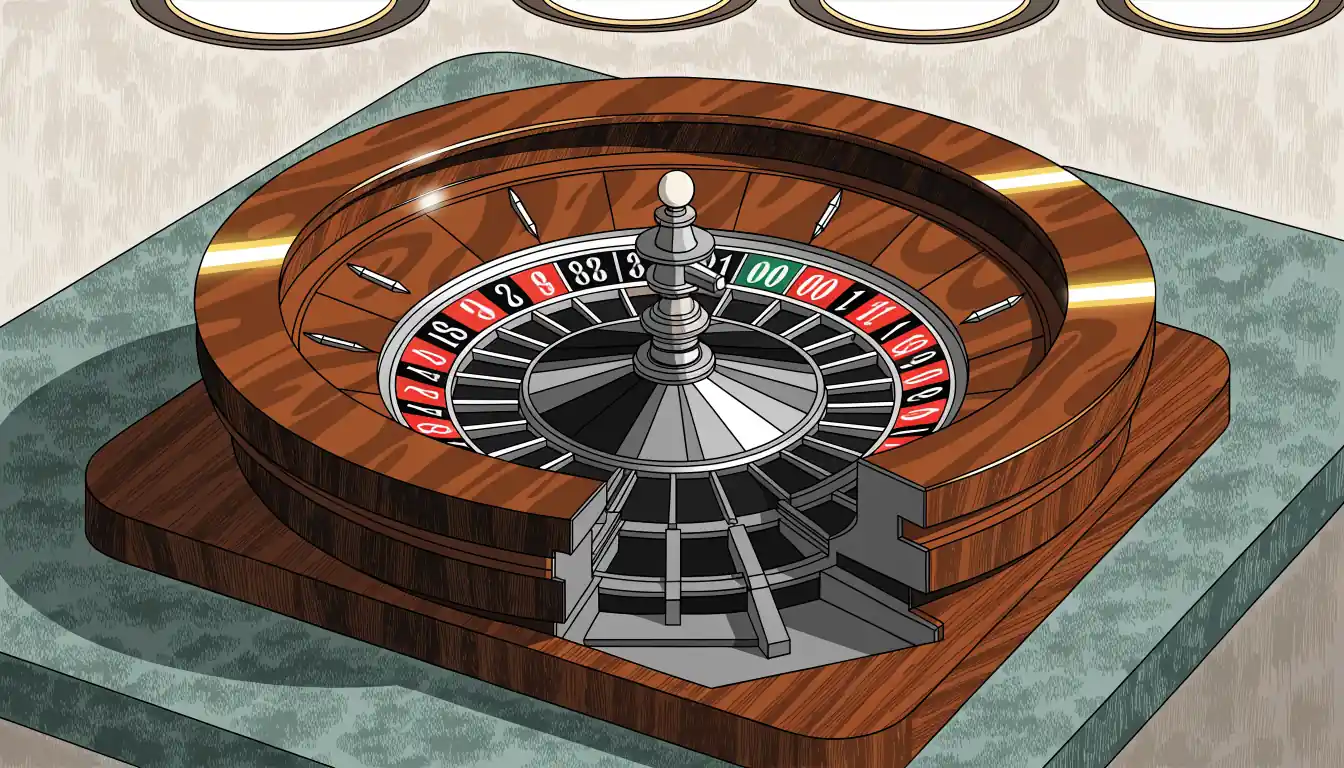
The basic structure is easy to recognise. A presenter stands beside a physical game wheel divided into numbered and feature sections. Players select an outcome before the wheel is spun. When the wheel stops, the winning segment determines the result. The presenter announces the outcome, keeps the pace moving and gives the game its show-business character. Between spins, the camera, graphics and commentary create a sense of occasion that a purely automated casino game rarely attempts.
The wheel contains regular number segments alongside Monopoly-themed features. The precise layout and available features belong to the game’s design rather than to the traditional board game itself. The numbers provide the straightforward part of the format: the wheel lands on one of them, and the corresponding outcome is settled. The feature spaces are where the theatrical machinery becomes more visible.
A landing on a feature can move the game away from the ordinary wheel result and into a bonus round. These rounds use the Monopoly setting more directly. A presenter may introduce a board-style screen, animated property imagery or a character from the game’s familiar universe. The bonus is not a second board game with a player-owned portfolio. It is another stage in the same chance-based entertainment, presented through the language of streets, buildings and prizes.
Games: Casino Slots, Live Tables and More
The most recognisable feature is the Monopoly board bonus, in which a token advances across a virtual board. The movement creates a visual journey through coloured properties and themed locations. Other features may involve a cash-grab-style sequence or a choice connected with Monopoly characters. Their common purpose is to turn a single wheel outcome into a more elaborate spectacle.
This is why the game can feel closer to a studio programme than to a quiet table in a casino. The presenter does not merely confirm the winning segment. The presenter introduces bonus events, reacts to the wheel and fills the pauses with commentary. Camera angles, sound effects and animated graphics make the result legible even when the action becomes busy. The atmosphere is carefully staged: the wheel is a prop, the board is a set of visual instructions, and the presenter is both host and referee.
The live element does not mean that the presenter decides the result. The wheel’s physical movement remains the visible centre of each round, while the game’s technical systems record the selected outcome and settle it. Human presentation and automated settlement therefore occupy different roles. One supplies ceremony; the other supplies the formal result.
Online Bingo UK: Bingo Rooms and Casino Games
That division is useful when placing Monopoly Live beside more traditional casino games. Roulette also revolves around a physical wheel and a final landing position, but its visual language is restrained and its table layout carries the meaning. Blackjack is organised around cards, decisions and a dealer. Monopoly Live replaces that quieter vocabulary with a brightly marked wheel, a television-style host and bonus sequences borrowed from a board-game world.
The Monopoly theme also explains the game’s broad appeal. It takes a recognisable cultural object and turns its pieces into a stage set. The coloured property groups, the familiar character imagery and the animated board create instant associations, even for someone who has not played the original game recently. A family board game becomes, in this setting, a piece of commercial entertainment. The transformation is revealing: the old domestic ritual of moving tokens around a table is recast as a polished studio performance.
Yet the theme should not be mistaken for a strategy layer. Knowing the order of the Monopoly streets does not confer an advantage in the live game. Nor does understanding how the board game’s rent system works explain the wheel’s results. The references are decorative and structural, not a hidden instruction manual. The game borrows Monopoly’s scenery without importing its competitive property management.
The phrase “live Monopoly casino” describes a live-broadcasted wheel game viewed via an online interface, rather than a literal digital version of the Monopoly board game.
The phrase “live Monopoly casino” can therefore describe the format, but not a literal online board game. The game is viewed through an online casino interface, while the wheel and presenter are part of a live broadcast from a studio. A player is not sitting at the studio table with the presenter; the player is watching the streamed event and making selections through the casino’s digital interface.
This combination gives Monopoly Live its particular identity. It is a wheel game, a bonus-game format and a piece of branded television, all at once. The board supplies the memory, the wheel supplies the suspense, and the presenter supplies the rhythm. Remove any one of those elements and the game would become something quite different.
For the UK market in 2026, the name is likely to be encountered in several word orders: live Monopoly, Monopoly casino and live casino Monopoly. They point to the same basic idea—a live-presented casino game built around a Monopoly-themed wheel—but the wording can make the format sound more complicated than it is. At heart, the mechanism remains direct: select, spin, observe and await the recorded result.
The spectacle is elaborate. The premise is not.
Top online casinos in the UK
- BritsinoBonus: Welcome Package – Get your £2,200 + 2,000 FS · Payout speed: 1-3 business days
- Revery PlayBonus: 100% up to€1,000+ 100 FS · Payout speed: 1-3 business days
- AmunbetBonus: Join now and get 450% up to 2,700 GBP + 450 FS · Payout speed: 1-3 business days
- ZombillionBonus: Welcome Pack 250% up to £4000 + 200 FS · Payout speed: 1-3 business days
- x3betBonus: Welcome Pack 100% Up to £1.000 + 200 Free Spins · Payout speed: 1-3 business days
- NightLuckBonus: Welcome Pack + 805% Up To 6400€ + 280 FS · Payout speed: 1-3 business days
- BeOnBetBonus: 100% up to €500 + 100 FS · Payout speed: 1-3 business days
How Monopoly Live Fits into a Live Casino
Monopoly Live belongs to the part of online gambling built around a live studio rather than a silent software screen. A presenter appears on camera, operates the game equipment, explains what is happening and keeps the pace moving. The result sits somewhere between a casino table and a television game show: the mechanics remain those of a wagering game, while the presentation borrows the atmosphere of broadcast entertainment.
Mines Casino Game UK: How Play and Risk Work
That distinction matters when considering how the game works. The studio is not merely decoration placed around a digital interface. It provides the visible setting in which the wheel is spun and the result is produced. Cameras, lighting, graphics and a presenter turn an otherwise brief event into a scheduled piece of entertainment. The Monopoly theme gives that format its board, properties and familiar visual language; the live-casino setting supplies the human host and the shared-room feeling.
A game show inside the live-casino family
Live casinos contain several different traditions under one roof. Some tables reproduce the formal rhythm of a conventional gaming floor, with a dealer handling cards or a wheel while the screen carries the action to a remote audience. Others are deliberately more theatrical. Monopoly Live is closer to the second group, alongside other presenter-led formats designed to feel like a game show rather than a quiet table session.
This does not make it a lottery, a television programme or a board game in the ordinary sense. It remains a casino game presented through a live stream. The host’s role is to guide the sequence, announce events and maintain the show’s rhythm; it does not turn the outcome into a performance that can be steered by personality or commentary. The bright set is theatre around chance. Nothing more mystical.
The wider live-casino catalogue also includes familiar table games. Roulette keeps the wheel and ball at the centre of attention. Blackjack places the dealer and cards in the foreground. Texas Hold’em brings a poker structure into the studio, while some operators offer specialist tables with their own presentation and limits. A live lobby may therefore place a game-show wheel beside traditional card and casino games, even though their visual identities are quite different.
Roulette Revolves around a physical wheel and a final landing position with a restrained visual language.
Blackjack Organised around cards, decisions, and a dealer.
Monopoly Live Uses a brightly marked wheel, a television-style host, and bonus sequences from a board-game world.
The studio as a new casino room
The growth of this format reflects a change in where a casino room can exist. A physical venue once supplied the dealer, table, spectators and architecture. A live studio separates those ingredients: the equipment and staff remain in a controlled location, while the broadcast carries the table to people using an online casino. The screen becomes the room’s entrance.
Grosvenor offers a useful British example of that development. In 2013, it unveiled live-casino games covering card and casino formats such as Blackjack, Texas Hold’em and Roulette. That launch illustrates the wider arrival of live dealing in the UK; it is not evidence that Monopoly Live itself formed part of that particular introduction.
Within this landscape, a Monopoly Live review is best understood as an assessment of presentation, rules and format—not a promise that the game-show styling changes the nature of chance. The attraction is the meeting of a recognisable board-game world with the live studio tradition. The wager remains the serious part.
Finding Monopoly Live at an Online Casino
Monopoly Live is normally encountered inside an online casino’s live-games lobby, alongside other streamed tables and game-show titles. It may appear under headings such as “Live Casino”, “Game Shows” or “All Games”, rather than in a separate Monopoly category. The exact layout depends on the operator’s website and the device being used.
A lobby search is often the quickest route. Entering “Monopoly” into the site’s game filter may bring up the title, while browsing the live section can reveal its tile, provider label and availability. Selecting the tile should open an information panel or the game interface, where the displayed rules, table status and wagering options can be checked before any account funding takes place.
Best Keno Online Casinos in the UK: How to Choose
That distinction matters because a casino can carry many live titles without carrying this particular one. A polished homepage is not evidence that Monopoly Live is available. Nor is a search result or an old promotional page proof that a game remains in the current lobby. Availability can change as operators adjust their catalogues, suppliers and regional offerings.
Checking the casino before registration
The phrase “best online casino with Monopoly Live” suggests a neat ranking, but there is no universal order that settles the question. A suitable choice depends on whether the game is actually available, whether the operator accepts customers in the relevant part of the United Kingdom, and whether its regulatory information can be verified.
For customers in Great Britain, the central check is the UK Gambling Commission’s public register. The Commission regulates commercial gambling there, including remote gambling and online casinos, and it is the sole regulator for commercial gambling in Great Britain. A remote operator serving consumers in Great Britain must hold the relevant operating licence, even when its key equipment or business operations are located elsewhere.
The register should be checked before an account is opened or money is deposited. The operator’s legal business name, trading details and website domain should correspond with what appears on the casino site. A logo or licence number displayed on a homepage is only a claim until it matches the Commission’s own record. Bureaucracy, in this case, is a useful form of architecture.
The Commission grants operating licences to businesses and personal licences to individuals working in regulated gambling. For a player assessing an online casino, the business operating licence is the material point: it connects the website offering Monopoly Live with the regulator responsible for that remote activity.
Checking an operator
- Verify the business name and domain against the UK Gambling Commission register
- Confirm the operator holds a valid operating licence for Great Britain
- Check that the licence details match the information on the casino site
Account safeguards worth checking
Registration should not be treated as a formality. A licensed operator must verify a customer’s age before allowing deposits into a gambling account. The account-opening process should also make clear which terms apply, what identity information may be requested and how account controls can be reached.
New customers must be prompted to set a financial limit before making a first deposit, with account-level controls available afterwards. These settings are more useful when they are visible in the account area rather than buried in a help page. The same practical inspection should cover self-exclusion and other responsible-gambling tools, although those controls belong to the wider account framework rather than to Monopoly Live itself.
Payment information deserves the same quiet scrutiny. UK-licensed casinos cannot accept credit cards for gambling, and a wallet funded by a credit card cannot be used as a workaround. If the payment page appears to invite that route, the site’s position and licence details require closer checking.
A live lobby can make a casino feel like a television channel with a cashier attached. The licence, account controls and payment rules determine whether the arrangement is fit for use. Gambling should remain limited to money that can be afforded to lose.
Choosing a Casino That Offers Monopoly Live
A casino carrying Monopoly Live is not automatically a suitable place to play it. The game may be familiar, the studio may look polished and the lobby may display a generous selection of tables, yet none of that establishes who operates the site or which rules govern the account. The sensible order is less glamorous: identify the operator, verify its authorisation, then examine the protections attached to the account.
Online Casino Without ID in the UK: What It Means
Start with the Gambling Commission register
Remote operators serving customers in Great Britain must hold the relevant licence from the UK Gambling Commission. The Commission is the sole regulator for commercial gambling in Great Britain, and its remit applies to online casinos even when the company or important equipment is located elsewhere. A casino with Monopoly Live should therefore be checked against the Commission’s public register before any deposit is made.
The register is more useful than a logo in a website footer. Search for the legal business name, trading name and domain associated with the casino, then compare the details with the site being considered. A brand can resemble another business, change its web address or present a group structure that is not obvious from the front page. The point is not simply to find a familiar name, but to establish that the particular service and its operator correspond with the authorisation shown publicly.
Best Low-Volatility Slots UK: How They Play
A specialist review has reported that the register dated 26 September 2026 did not show a LuckyPays entry under that brand or its stated domain, including luckypays.io. That is a time-specific observation, not a permanent description of the register. Licensing information can change, so the live public record remains the proper reference rather than an old article, badge or search result.
The distinction matters because offshore casinos may be accessible from Britain while operating outside the UK regulatory system. Accessibility is not the same as British authorisation. A casino site that accepts British customers without the required local licence does not acquire one merely by offering familiar games or displaying responsible-gambling language.
Examine what happens when something goes wrong
A trustworthy casino is not defined only by successful play. Its complaint route deserves attention before an account is funded, when the terms are still easier to read and nobody is trying to recover a disputed payment or missing balance.
Complaints and Disputes
UK Gambling Commission licensees must provide an internal complaints process. A trustworthy casino should explain how to submit a complaint and how the matter progresses.
Access to an approved Alternative Dispute Resolution (ADR) service is also an important checkpoint for unresolved disputes.
UK Gambling Commission licensees must provide an internal complaints process. The casino should explain where a complaint is submitted, what information should accompany it and how the matter progresses if the first response is unsatisfactory. Vague invitations to “contact support” are less useful than a clearly labelled complaints policy with a business identity attached.
Access to an approved Alternative Dispute Resolution service is another important checkpoint. ADR does not mean that every complaint will be decided in the customer’s favour, nor does it replace the operator’s own process. It does provide a route beyond the casino when an eligible dispute remains unresolved. The relevant ADR provider and the circumstances in which it can become involved should be identifiable in the terms or complaints information.
A casino’s support channels can also reveal the quality of its administration. Live chat may help with a simple account question, but a formal complaint normally requires written records, dates and the exact issue in dispute. Screenshots, transaction references and copies of correspondence can make the history intelligible. Good housekeeping is dull; it is also useful.
Look for controls that work at account level
Responsible gambling should appear as a working part of the account, not as a slogan placed beneath the game lobby. UK-licensed casinos must provide tools including self-exclusion, and remote operators must prompt new customers to set a financial limit before the first deposit. Account-level controls should remain accessible afterwards, rather than being buried in a page that is difficult to find once play has begun.
The useful questions are practical:
- Can a financial limit be set before depositing?
- Can the limit be reviewed in the account area?
- Is self-exclusion clearly explained?
- Are the available controls distinct from promotional preferences?
- Does the site provide information about gambling support?
GAMSTOP is the national online self-exclusion programme relevant to participating gambling businesses in Great Britain. A casino’s own self-exclusion process and GAMSTOP are related safeguards, but they are not the same setting on a website. The terms should explain how exclusion affects the account, access to gambling products and communications.
Operators are also required to contribute to the Research, Education and Treatment levy. That obligation is part of the regulated framework, not a marketing feature that proves a particular site is especially considerate. The more telling signs are whether limits are presented before the first deposit, whether exclusion information is intelligible and whether support is available without a struggle.
Read the terms behind the Monopoly Live tile
The presence of a Monopoly Live tile says little about the rest of the relationship between casino and customer. The general terms should identify the contracting company, applicable law, account rules, verification requirements, withdrawal conditions and complaint arrangements. The game’s own information should sit alongside those broader terms, not substitute for them.
Particular care belongs to wording about promotions. A bonus can make a casino appear attractive while attaching conditions that affect which games count, how funds may be withdrawn or when an offer ends. Promotional language is often large; the restrictions tend to be smaller. That typographical tradition has survived remarkably well.
Payment information is another basic test. Remote operators cannot accept credit-card payments for gambling, including credit-card funding routed through a money service business. They also cannot accept wallet payments where the wallet permits credit-card funds to be used for gambling. A site’s payment page should not encourage an arrangement that conflicts with those restrictions.
Payment Restrictions
UK-licensed casinos cannot accept credit cards for gambling, nor can they accept wallet payments that permit credit-card funds to be used.
None of these checks establishes that Monopoly Live will produce a favourable result. They establish something more modest and more valuable: who is responsible for the account, which protections are available and where a dispute can go. Among casinos with Monopoly Live, the better choice is therefore not the one making the loudest claim to be “best”. It is the one whose licence, terms, limits and complaints route remain clear when the entertainment falls away.
Playing for Real Money: Limits and Safeguards
Real-money play begins with an account, not with the wheel. In Great Britain, a remote operator must confirm that a customer is aged 18 or over before allowing a deposit into a gambling account. That check is more than a formality: it is the first barrier between entertainment and an account funded by someone who should not be there.
The second barrier is financial control. New customers must be prompted to set a financial limit before making their first deposit, and the account must provide accessible controls for changing limits later. These tools can cover deposits or other forms of spending, depending on how the operator has designed its account system. Their value is practical rather than decorative: a limit set before play is harder to negotiate with in the middle of it.
A Monopoly Live bonus, where offered, does not alter those responsibilities. Promotional funds may come with separate conditions, but the ordinary safeguards still apply. The presence of a bonus is not a reason to raise a limit, and a game described as the best choice does not become financially safer through advertising language. Marketing has never been a responsible-gambling tool.
Which stake limits apply?
A specialist review gives the following specific description of Great Britain’s online-slot limits: an adult aged 25 or over may stake no more than £5 per game cycle, while an adult aged 18 to 24 may stake no more than £2 per game cycle. Those limits concern online slots. They do not apply to roulette or blackjack.
Online Casino Tournaments UK: Rules, Prizes and Entry
That distinction matters when people look for Monopoly Live rules or compare the game with other casino tables. A live wheel-based casino game should not automatically be treated as an online slot merely because it is played through a website. The applicable product category and the operator’s presentation determine which controls are relevant. In any event, the absence of a slot stake cap does not make a larger wager sensible.
Britain also prohibits online slot autoplay, and each online slot game cycle must last at least 2.5 seconds before another can begin. Those provisions belong to slots rather than being general instructions for every live casino game. Confusing the categories can make a neat-sounding rule misleading.
Payments and account protection
Credit cards cannot be used for gambling with UK-licensed casinos. The restriction also covers credit-card funding routed through a money service business, and a wallet cannot be used where it permits credit-card funds to reach gambling. A payment method that appears separate from a card does not necessarily escape the restriction.
Self-exclusion provides a more decisive form of protection. UK-licensed casinos must offer responsible-gambling tools, including self-exclusion, and GAMSTOP can be relevant across participating online gambling accounts. Self-exclusion is not a temporary spending suggestion; it is a decision to block access for a chosen period. Account limits are useful earlier, before the situation has become unmanageable.
Licensed operators must also provide an internal complaints process and access to an approved Alternative Dispute Resolution service. That route concerns disputes with the operator, not the outcome of a particular spin or the result of a game. A complaint cannot turn an ordinary loss into a refund simply because the result felt harsh.
Essential Rule
Gambling should remain limited to money that can be afforded to lose.
The central rule remains less technical than the rest: gambling belongs within money that can be afforded to lose. No bonus, result history or table label changes that boundary.
A Demo Before the Real-Money Game
A demo version of Monopoly Live is best understood as an introduction to the room rather than a rehearsal for victory. It allows the interface, wheel, board and presentation to be explored without placing a financial stake on the outcome. That distinction matters because the visual language is unusually busy: a live host, a numbered wheel, Monopoly properties, bonus spaces and animated effects all compete for attention. Familiarity can make the format clearer. It cannot make chance obedient.
What the demo makes visible
The free-play version generally presents the same broad sequence as the real-money game. The wheel is spun, the result determines the relevant space, and the presentation explains what follows. The important buttons and labels remain in view, while the surrounding graphics provide the atmosphere that makes the game resemble a television show more than a traditional online table.
This is where a first session has practical value. A player can establish:
- where the wager controls are placed;
- how the available options are labelled;
- which part of the screen displays the wheel result;
- how the board spaces and bonus features are shown;
- where the game records the latest outcome;
- how the host’s announcements relate to the on-screen action;
- whether the layout remains readable on a smaller screen.
The exercise is modest, but useful. Confusion is expensive when real money is involved, even before the outcome itself is considered.
A demo can also reveal the rhythm of a round. There is a point at which selections close, a spin, a result, and then the next opportunity. Watching that order without financial pressure leaves more attention for the actual rules. The game stops looking like a rapid stream of colour and begins to look like a sequence of defined stages.
How to play Monopoly Live in demo mode
The exact menu wording varies between casino sites and devices, but the usual route is straightforward. Monopoly Live is selected from the live-casino lobby, after which a free-play or demo option may appear alongside the real-money table. Some services make the practice mode easy to find; others place it behind a game-information panel or offer it only on certain versions of the lobby.
Plinko Casino UK: How the Online Game Works
Once the table opens, the sensible first pass is observational. The wheel can be watched without immediately trying to predict a result. The board can be examined to see which spaces carry ordinary outcomes and which trigger the themed features. The host’s explanation can be followed from the beginning of the round rather than treated as background noise.
A second pass can focus on the controls. A notional selection can be made, the confirmation stage observed, and the result followed through to the settlement screen. This is not a method for discovering a profitable pattern. It is closer to learning the controls of unfamiliar software before using it for something consequential.
The same principle applies when the game is opened on a mobile device. A Monopoly Live casino app may be a dedicated application, a casino’s mobile application, or simply a browser-based version designed for a phone. The label matters less than the function. The display should show the wheel, game information and controls clearly enough that a selection is not made by accident. A smaller screen can turn a decorative feature into a practical obstruction.
- Use a demo to learn interface controls and game rhythm
- Observe how bonus features are triggered
- Verify legal licensing before depositing funds
- Use practice sessions to search for winning systems
- Assume previous results predict future outcomes
- Treat a game-show atmosphere as a guarantee of profit
What practice cannot establish
The demo does not provide a statistical advantage. It cannot show that a particular number, colour, property or bonus space is “due”. It cannot turn a run of similar results into a forecast, and it cannot establish that a sequence observed in free play will continue when money is added.
Nor does repeated practice alter the underlying nature of the game. A person may become quicker at reading the interface, but speed is not predictive power. The host may appear familiar, the wheel may feel recognisable, and the board may seem to acquire a personality. None of those impressions changes the uncertainty of the next result.
This is the quiet trap in many practice modes: the absence of financial risk can make extended play feel like study. Some study it is, in the narrow sense of learning where the buttons are. It is not evidence of a winning system. The screen teaches operation, not prophecy.
Using a demo sensibly
A short, purposeful session is more useful than an endless one. The first aim can be to identify the game’s stages and controls. The next can be to check how the table behaves when a round ends and another begins. If the display includes help information, that material deserves attention before the animated features do; spectacle has never been a substitute for instructions.
It is also worth separating three kinds of familiarity:
- Interface familiarity — knowing where selections, confirmation controls and result information appear.
- Format familiarity — understanding the relationship between the wheel, board spaces, host and bonus features.
- Outcome expectation — believing that previous demo results reveal what will happen next.
The first two can be useful. The third is where practice starts pretending to be evidence.
A demo may also help clarify personal reactions to the format. The live presentation, pauses between rounds and dramatic bonus sequences are part of the experience, not merely decoration. Some players find them entertaining; others find the pace or excitement uncomfortable. Discovering that before real-money play is a reasonable use of free mode. Gambling is not improved by discovering its pressure only after money has entered the picture.
Free play is not a promise
“Play Monopoly Live for free” sounds simple, but free access can mean different things. One casino may provide a genuine demonstration mode; another may show a preview, a rules page or a table that requires an account before it can be opened. The label should therefore be read alongside the game’s actual behaviour. A mode that does not permit a financial wager is practice, regardless of how lavishly it is presented. A mode that leads directly into a deposit path is something else and deserves more careful attention.
The demo is most valuable when it answers practical questions: Is the format understandable? Are the controls visible? Does the mobile layout work? Is the pace comfortable? Does the game remain enjoyable without the illusion that a result can be mastered?
Those answers belong to the player’s experience of the product. They say nothing reliable about future outcomes. Free mode is a map of the room, not a map of chance.
Does a history tracker predict future results?
No. A tracker records past outcomes, but the wheel and the rules do not change based on previous results. Randomness does not guarantee a balance over short runs.
Can I play Monopoly Live for free?
Yes, many casinos offer a demo or free-play version. This allows you to explore the interface, controls, and rhythm without placing a financial stake.
Results, Randomness and the Limits of a Tracker
A record of previous Monopoly Live results can be interesting without becoming a map of what happens next. History describes completed rounds; it does not alter the wheel, the board or the rules governing the next game cycle. The distinction is easy to lose when a sequence is displayed neatly in columns, coloured symbols or running totals. Order creates a story, even where the underlying events remain separate.
Statistics can summarise what has already occurred. A tracker might group results by wheel segment, bonus feature or board outcome, allowing patterns in the recorded sample to be seen. That may help with observation and record-keeping. It cannot establish that a particular outcome is “due”, nor can it make an infrequent result more likely merely because it has been absent from recent records.
Randomness is not obliged to look balanced over a short run. Several similar results may appear together; an apparently neglected outcome may remain absent. Neither situation supplies a reliable instruction for the next wager. The wheel does not remember that a result has appeared repeatedly, and it does not compensate for a result that has not appeared. A tracker remembers. The game does not.
What a history can show
A personal record may help separate impressions from actual observations. It can show which rounds were included, how they were categorised and whether a perceived pattern survived careful checking. It may also reveal how quickly attention turns a neutral sequence into a theory. That is a useful lesson, though not a wagering system.
The quality of any record matters. A partial history, an incorrectly labelled outcome or a tracker that mixes different game formats can produce a confident-looking summary with a weak foundation. Even an accurate record remains retrospective. It reports the past rather than offering a forecast.
Strategy without prediction
A sensible approach to strategy concerns decisions that remain under a player’s control: setting a spending boundary, deciding when to stop and refusing to treat a run of results as evidence of an advantage. It does not consist of selecting a segment because recent results appear to favour it. Nor does it turn statistics into a promise of value.
Crazy Time Live Casino Game Show: UK Guide
This matters particularly when a tracker presents percentages, streaks or “hot” and “cold” labels. Such language may describe the display, but it can quietly suggest predictive power. A number calculated from earlier rounds is not proof of the next outcome. The presentation may be polished; chance remains unmoved.
Records can support curiosity and discipline. They cannot remove uncertainty, guarantee a result or transform past play into a dependable method. Gambling should remain limited to money that can be afforded to lose.
What a Monopoly Live Review Can—and Cannot—Tell You
A careful Monopoly Live review can describe the experience: how the presenter conducts the show, how the wheel and board interact, whether the interface is clear, and how easily the game’s different features can be followed. It may also compare the format with more conventional live tables, where the atmosphere is less television studio and more quiet felt.
That is useful information, but it is not a promise of value. A review cannot establish that a particular session will produce a favourable result, that one property will appear at the right moment, or that a feature will compensate for losing rounds. Presentation and probability are separate things. A polished studio does not make chance less capricious.
Free play has a similarly modest purpose. It can make the controls, terminology and sequence of play familiar without putting money into the outcome. This may help distinguish genuine interest in the format from confusion about its mechanics. It cannot demonstrate a winning system, reveal a dependable pattern or turn a random game into a predictable one. Practice removes some unfamiliarity, not uncertainty.
The most honest assessment therefore stays close to what can actually be observed. It discusses design, pacing, clarity and the character of the live presentation, while leaving claims about guaranteed returns outside the review. “Guaranteed” is a large word for a game governed by chance.
For anyone moving from a free version to real-money play, the boundary matters. Gambling is legal for adults at UK-licensed online casinos, but legality is not a promise of profit. The sensible limit is personal and unglamorous: only money that can be afforded to lose should be used, and play should stop when that condition no longer holds.
Are online casino games licensed and regulated?
Yes. The UK Gambling Commission regulates online gambling offered to consumers in Great Britain, and remote operators serving them must hold the relevant licence.
What are the online slot stake limits in Great Britain?
The limit is £5 per game cycle for adults aged 25 and over, and £2 for adults aged 18 to 24. These limits do not apply to roulette or blackjack.
Is LuckyPays licensed by the UK Gambling Commission?
The Gambling Commission register dated 26 September 2026 does not list LuckyPays under its brand or stated domain, including luckypays.io.
Created by the "Casino not on Gamstop" editorial team.